Back to Blog
LPG Container Separation Distances
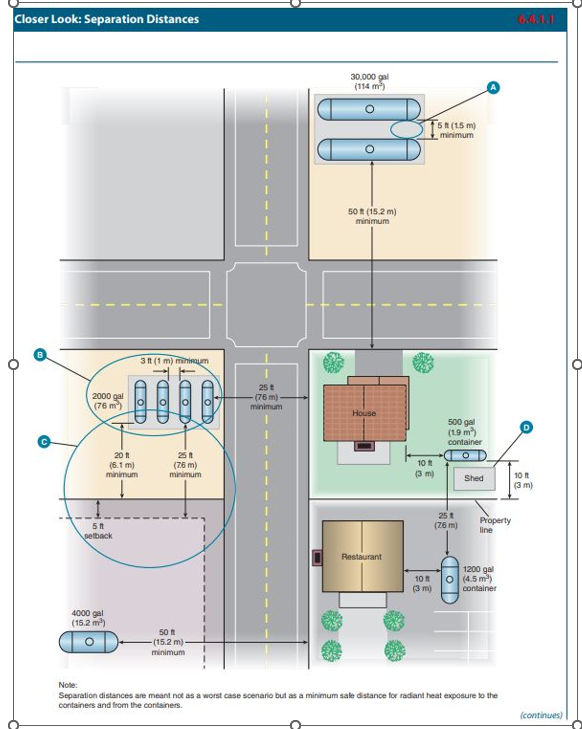
LP-Gas containers shall be located outside of buildings unless they are specifically allowed to be located inside of buildings.
The siting criteria require that a container be located a specified distance from other containers,
an important building or group of buildings, or a line of adjoining property that can be built upon. These separation distances are intended to reflect the container’s relative exposure hazard due to the presence of the items cited, and vice versa. The distances are based on a combination of the following factors:
● Potential hazard of LP-Gas
● Size and type of equipment used to contain it
● Possibility of leaks (which can ignite)
● Need for fuel in buildings
If the LP-Gas located within the buildings then serval requirement and separation distance to be considered by different positions locations of containers below is the table as per NFPA 58 showing the required distance to be considered:
As we can from the table first Colum shows the water capacity per containers in (gal and m3).
Second Colum shows the minimum separation distances between containers, Important buildings, and Line of adjoining property that can be built upon for mounded or underground containers
in (ft and m).
Third Colum shows the minimum separation distances between containers, Important buildings, and Line of adjoining property that can be built upon for aboveground containers in (ft and m).
Fourth Colum shows the minimum separation distances between containers.
How Are Separation Distances Determined?
When separation distances are measured between aboveground containers, the measurement is made to the closest surface of the container as illustrated in "A." Separation distances between underground or mounded containers are made from the container surface.
In addition, no part of an underground or mounded container is permitted to be less than 10 ft (3 m) from a building or line of adjoining property that can be built upon.
When Is Aggregate Capacity Used?
"B" illustrates a group of containers that might be commonly encountered in the field. In this scenario, the separation distance would not be determined by the aggregate capacity. The first column in Table 6.4.1.1, “Water Capacity per Container,” means that the aggregate (total) capacity of multiple containers is not used when determining separation distances of containers to an important building, group of buildings, or line of adjoining property that can be built upon. The only time the aggregate capacity is used is when the water capacity of containers of less than 125 gal (0 5 m3 ) exceeds 500 gal (1.9 m3 ), as stated in 6.4.3.2. Use the capacity of the largest container in a group when using Table 6.4.1.1.
What does “line of adjoining property that can be built upon” mean?
Most interpretations of “line of adjoining property that can be built upon” in 6.4.1.1 are regarding the application of local zoning ordinances. Setbacks are often written into the zoning ordinances to clarify how close a building can be placed in relation to a property line, as shown in "C." Any discrepancy in the zoning laws should be taken into account by the AHJ when reviewing applications. The intent of the code is to provide separation from buildings, those that are existing or those that could be built in the future, not an imaginary line. Setbacks can be problematic to use when applied to the location of LP-Gas containers. In some jurisdictions, setbacks may not apply to heat pumps, gas packs, air-conditioning units, and other devices that may be sources of ignition.
What is an important building?
An “important building” can be considered important by different individuals for different reasons, which leaves this classification up to the user’s own interpretation of the code. A building can be considered important for a number of reasons such as high replacement value, its human occupancy, or vital importance of contents to a business. Human occupancy may be constant or might only be for brief periods of time. A building with characteristics that hinder emergency responders’ access and ability to safely apply water to a tank or act as an impediment to applying water should also be considered an important building. "D" shows a possible example of what might not be considered an “important building” by some AHJs, but may be considered an “important building” by others.
Aboveground Containers.
Containers installed outside of buildings, whether of the portable type replaced on a cylinder exchange basis or permanently installed and refilled at the installation, shall be located with respect to the adjacent containers, important building, group of buildings, or line of adjoining property that can be built upon.
The 25 ft (7.6 m) minimum distance from aboveground ASME containers of 501 gal through 2000 gal (1.9 m3 through 7.6 m3 ) water capacity to buildings, a group of buildings, or the line of adjoining property that can be built upon shall be reduced to 10 ft (3 m) for a single ASME container of 1200 gal (4.5 m3 ) or less water capacity where such container is at least 25 ft (7 6 m) from any other LP-Gas container of more than 125 gal (0 5 m3 ) water capacity.
Underground or Mounded ASME Containers.
Distances for all underground and mounded ASME containers shall be measured from the container surface.
No part of an underground or mounded ASME container shall be less than 10 ft (3 m) from a building or line of adjoining property that can be built upon.
If more than one such installation is made, each installation shall be separated from any other installation by at least 25 ft (7.6 m).
References,
NFPA 58
NFPA 58 HANDBOOK.
SBC 801.
END OF NOTE.